
First published in PTQ, Q1 2026
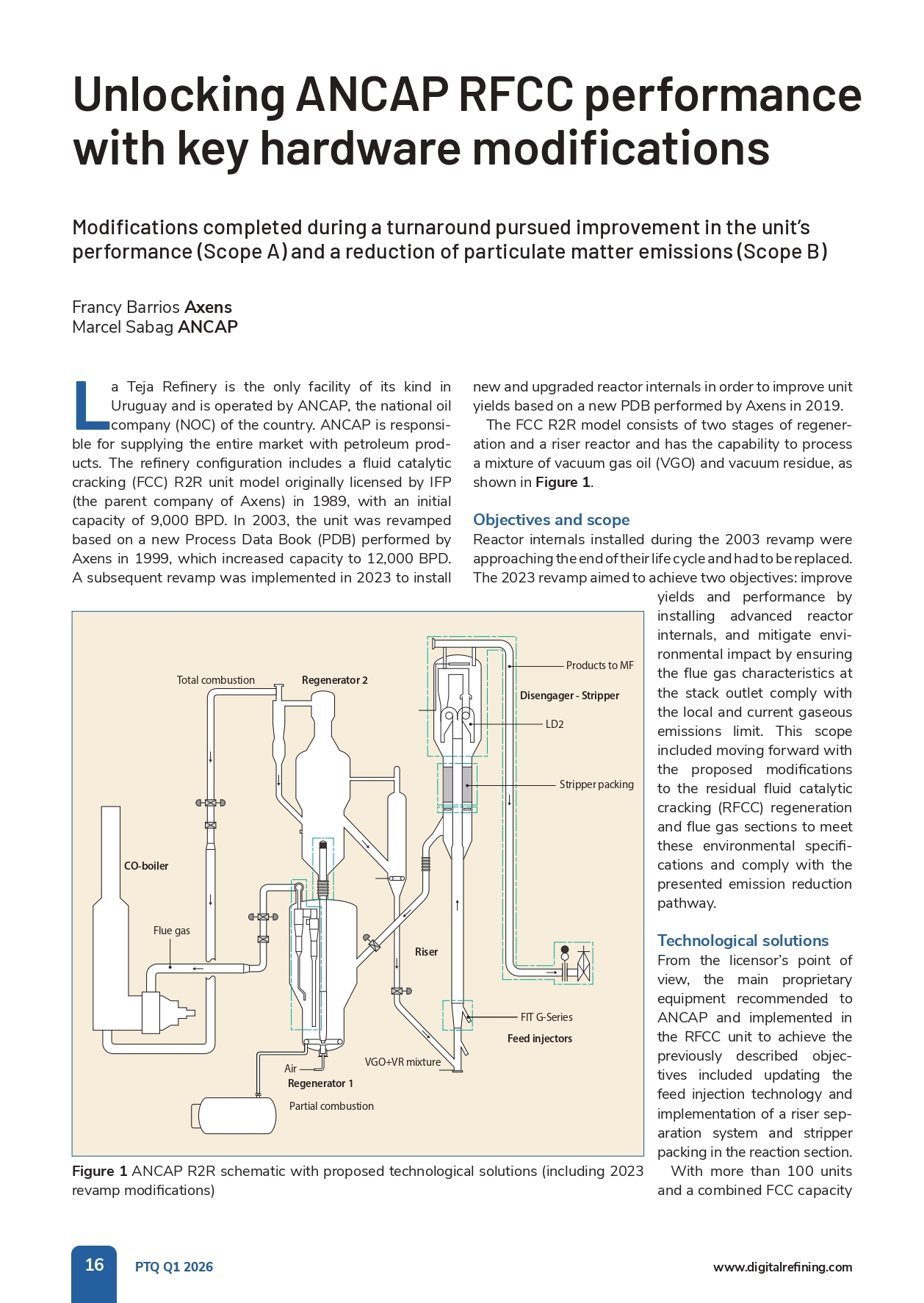
This article published in Hydrocarbon Processing and written by Francy Barrios, Lead Technology Engineer, and Marcel Sabag, Refining Professional at ANCAP, presents the successful revamp of ANCAP’s Residual Fluid Catalytic Cracking (RFCC) unit at the La Teja refinery in Uruguay, aimed at improving performance while significantly reducing environmental impact. Through the installation of advanced reactor internals and upgraded feed injection, separation, and stripping technologies, the project delivered higher unit conversion, increased gasoline and LPG yields, and a substantial reduction in particulate matter emissions. Test runs and simulation results confirm improved operability, lower dry gas production, reduced steam consumption, and enhanced flexibility for processing higher-residue feeds. Overall, the revamp demonstrates how targeted hardware innovations can unlock FCC performance while supporting stricter environmental compliance.